
Ceramic Window Tint in Independence, MO
Ceramic tint at Trimline starts at $139 for the driver and passenger windows and $349 for a full small car or SUV. At every shade we publish data for, it blocks far more infrared than our standard film, even at the light 50% shade. Every install is backed by a limited lifetime warranty. Family-owned in Independence since 1975, serving the Kansas City metro.
Tesla models have their own pricing — see Tesla window tinting prices.
Ceramic Window Tint Prices
Clear, up-front prices. Standard film is shown for comparison.
Driver & passenger windows
- Standard
- $89
- Ceramic
- $139
- IR
- $179
Full tint — small car/SUV
- Standard
- $219
- Ceramic
- $349
- IR
- $469
Full tint — large truck/SUV
- Standard
- $279
- Ceramic
- $399
- IR
- $529
| Coverage | Standard | Ceramic | IR |
|---|---|---|---|
| Driver & passenger windows | $89 | $139 | $179 |
| Full tint — small car/SUV | $219 | $349 | $469 |
| Full tint — large truck/SUV | $279 | $399 | $529 |
Full tint covers the rear glass and every side and quarter window. Sunroofs, add-ons, and package deals are on our pricing page. Tesla models are priced separately — see Tesla window tinting prices.
Is Ceramic Tint Worth It?
Our recommendation for most daily drivers is yes. At the 20% shade, ceramic film rejects 56.4% of total solar energy versus 46.4% for standard film, and 84.5% of infrared versus 39.2%. If privacy and looks on a tight budget are your main goals, standard film is still a solid choice.
Standard Film
Best for privacy and looks on a budget. Blocks 99% or more of UV and cuts glare.
Ceramic Film
Best for daily drivers and cars that park outside. At the light 50% shade, it rejects 76.7% of infrared, versus 23.2% for standard film.
IR Film
Our highest-performing film. It rejects 94.4% to 95.6% of infrared at the 5%, 20%, and 50% shades, and has the highest total solar energy rejection of our three films at each of those shades.
Heat Rejection by Shade
Manufacturer-published figures for the films we install, at the 5%, 20%, and 50% shade labels. The data sheets don't state the test glass or test standard, so these aren't measurements of your vehicle's windows.
5% shade
Total solar energy rejected
- Standard
- 58.7%
- Ceramic
- 65.7%
- IR
- 69.4%
Infrared rejected
- Standard
- 55.0%
- Ceramic
- 89.9%
- IR
- 95.6%
20% shade
Total solar energy rejected
- Standard
- 46.4%
- Ceramic
- 56.4%
- IR
- 62.7%
Infrared rejected
- Standard
- 39.2%
- Ceramic
- 84.5%
- IR
- 94.4%
50% shade
Total solar energy rejected
- Standard
- 28.2%
- Ceramic
- 39.5%
- IR
- 54.6%
Infrared rejected
- Standard
- 23.2%
- Ceramic
- 76.7%
- IR
- 95.0%
- Total solar energy rejected (TSER) and infrared rejection are separate figures. Infrared rejection is measured across 780–2500 nm.
- All three films block 99% or more of UV rays.
- Shade labels are nominal. Published light transmission for Standard / Ceramic / IR: 6% / 5% / 6% at the 5% label; 20% / 19% / 20% at the 20% label; 51% / 51% / 48% at the 50% label.
- We also carry 15%, 35%, and 70% (70% in Ceramic and IR only). No published figures for those shades appear here.
What the Numbers Mean
Visible light transmission (VLT). How much visible light gets through. A lower number means darker tint. Legal limits apply to the finished window, glass and film together, not just the film's shade label.
Total solar energy rejected (TSER). The share of the sun's total energy (visible light, infrared, and UV) that the film rejects, as reported by the manufacturer for a given shade.
Infrared rejection. How much of the sun's infrared the film rejects. Infrared is a major part of the heat you feel from sunlight. Compare it separately from TSER.
99% UV isn't 99% heat. UV blocking protects your skin and your interior, but UV is only a small part of the sun's energy. All three of our films block 99% or more of UV. The big differences between them show up in infrared and total solar energy rejection.
Darker doesn't automatically mean more heat rejection. Our IR film at the light 50% shade rejects 54.6% of total solar energy, more than our standard film at the darker 20% shade (46.4%). Compare both the film and the shade.
Legal Tint in Missouri and Kansas
Tint laws measure the finished window, glass and film together. In Missouri, front side windows must let in at least 35% of visible light, and there's no darkness limit on the windows behind the driver. Kansas requires at least 35% on the front side windows, the rear side windows, and the rear window, with no exception for SUVs or trucks, and the film must be nonreflective.
Because both states limit how dark the front windows can go, the film's own heat rejection matters. At the 50% shade, our ceramic film rejects 76.7% of infrared and our IR film 95.0%, versus 23.2% for standard. All three of our films are nonreflective.
See our full Missouri vs Kansas tint law guide.
Installation and Aftercare
Driver and passenger windows take about 20 to 30 minutes. A full tint takes about 1.5 to 2 hours, with larger SUVs closer to 2 hours.
After installation, keep your windows rolled up for about 3 days. If you have any questions about your film's appearance or aftercare, give us a call.
Limited Lifetime Warranty
Every ceramic and IR install comes with a limited lifetime warranty covering fading, peeling, cracking, delamination, and adhesive failure. If your film has a covered defect, we fix it, including the labor.
Ceramic Tint for Teslas and EVs
Our ceramic and IR films contain no metal and are nonreflective, and the manufacturer rates them for no interference with GPS, phone, or radio signals. Compare them for your Tesla or EV using the figures by shade above. Tesla models have their own per-model pricing — see Tesla window tinting prices.
Ceramic Tint FAQ
Get Ceramic Tint in Independence
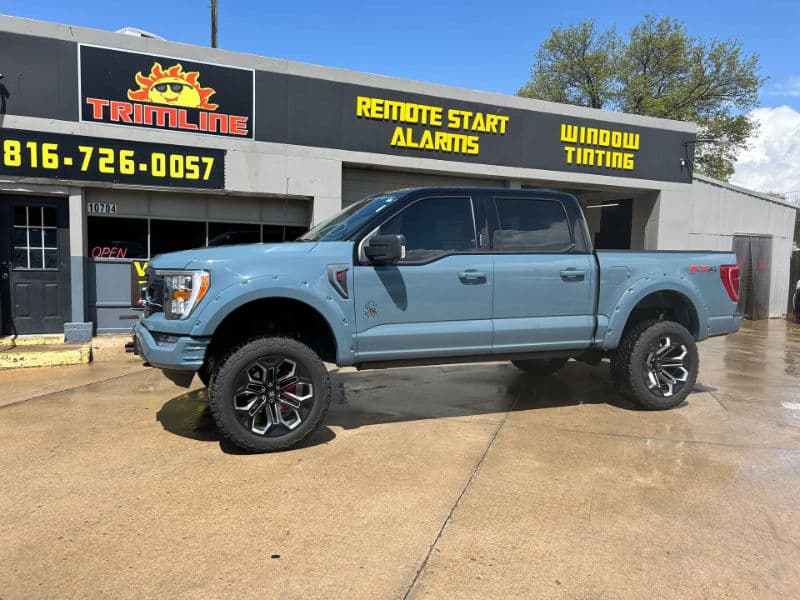
Jim Martin founded Trimline in 1975. His daughters helped over the years, and his grandson Jordan runs the business today. Stop by 10704 East 23rd St S or book online.
- Monday – Friday:
- 9:00 AM – 5:00 PM
- Saturday:
- 9:00 AM – 3:00 PM
- Sunday:
- Closed